Showing posts with label Wine Country. Show all posts

Thursday, May 12, 2011

WINE COUNTRY: MASSACHUSETTS - CAPE COD WINERY


The Now And Zin Wine Country series continues with the wine of Massachusetts.  The wine industry in The Bay State is still in its infancy by modern standards, although wine has been produced in Massachusetts since the 1600s.  The Pilgrims had barely gotten off the Mayflower when they started making wine from indigenous grapes.

Massachusetts now has over 30 wineries producing over 160,000 gallons of wine per year.  Most of the wineries are in the southern portion of the state.

Cape Cod Winery was founded in 1994 by the Lazzari family.  The winery is located in the Southeasten New England AVA.  In the sandy, gravelly soil of their gently sloping vineyards in East Falmouth, Massachusetts, the Lazzaris grow Cabernet Sauvignon, Cabernet Franc, Merlot and Pinot Grigio grapes.  They also grow Seyval and Vidal, and the wine I tasted is a blend of those two white grapes.

Cape Cod Winery Nobska WhiteCape Cod Winery's Nobska White blends Seyval Blanc and Vidal Blanc to produce a semi-sweet white wine with only 12% alcohol content.  Both are hybrid grapes, with Seyval ripening early and well suited to cold weather and Vidal noted for its elevated sugar content and high acidity.

Nobska White has a beautiful golden color in the glass and is quite aromatic, with a candy-like aroma of guava-meets-cognac.  A honey component joins a green pepper scent on the nose as well.  The flavor is strongly tropical and finishes like a lemon-lime Sweet Tart.  The wine is well suited for pairing with seafood with an acidity level that, while not razor sharp, is crisp and refreshing.  The mouthfeel is rather full - it feels almost creamy in the mouth - and should be served chilled for best effect.

I would imagine Cape Cod Winery's Nobska White would be a perfect wine to sip on the deck during warm summertime weather.

Cape Cod Winery also makes two red blends - one of Cabernet Sauvignon and Cabernet Franc and the other a Merlot/Cabernet Franc mix.  The winery's blush is created using their Seyval grapes and organic Cape Cod cranberries.


Follow Randy Fuller on Twitter

Tuesday, May 10, 2011

DRINK LOCAL WINE


Wine Writing

If you have yet to check out the website DrinkLocalWine.com, you really should surf by and take a look.  The site aims to shed light on the wines of regions other than California, Oregon, Washington.  Most wines produced in America come from those three states, but wine is produced in all 50 states, so why not explore the wine produced where you live?  Food lovers are doing it with the locavore movement.  Why not local wine?

Drink Local Wine is the brainchild of Washington Post wine columnist Dave McIntyre and journalist Jeff Siegel.  Their site was featured in an article in WineBusiness.com.

The site has partnered with Texas, Virginia and Missouri on major events promoting the wines in those states and they have another regional conference planned in Colorado.

Now And Zin's Wine Country series is currently attempting to explore wines from all over America, on a somewhat smaller scale.

Thursday, April 14, 2011

WINE COUNTRY: MINNESOTA - FIELDSTONE VINEYARDS

The Now And Zin Wine Country series keeps rolling across America, shedding a little light on wine producing areas somewhat lesser-known than California.

Minnesota - The North Star State - has been billed on the state's license plates as "The Land Of 10,000 Lakes."  I'm told that lakes actually number closer to 12,000 in Minnesota, but who's counting?  Apparently someone is, but let's just say there are way more lakes than vineyards in Minnesota.

We'll keep an eye on that, though, because the Minnesota grape industry has seen huge growth in recent years.  The number of vineyards in the state doubled between 2003 and 2008.  Even so, the state's grape and wine industries are still young.  Minnesota's wine production in 2009 was ranked the eighth lowest in America, at just over 114,000 gallons.

It gets cold in Minnesota, so winemakers there rely largely on grape varieties that are hardy enough to survive the winters.  French hybrids are popular, and the state has even created its own varieties like Edelweiss and St. Croix specifically for their cold weather durability.  The University of Minnesota's oenology program came up with the Frontenac and Marquette grapes.

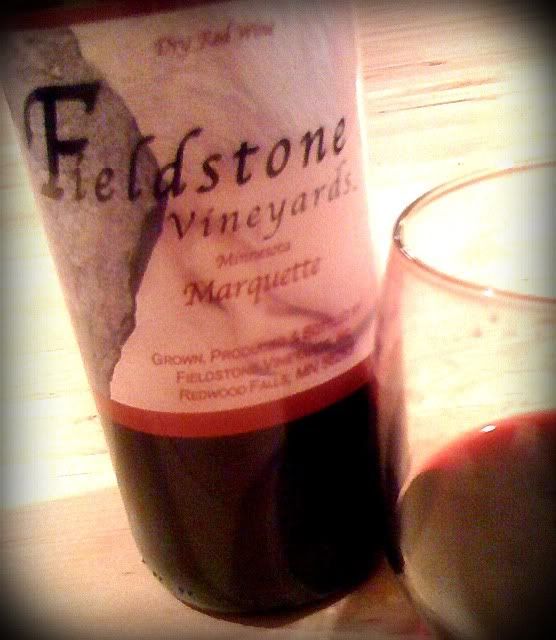
Fieldstone Vineyards Marquette Fieldstone Vineyards in Redwood Falls, Minnesota responded to my request for an entry in this series.  Thanks to owner Charles M. Quast and owner/winemaker Mark Wedge, who provided me with a bottle of their Marquette wine to sample.

Fieldstone is the state's largest 100% Minnesota-grown winery, and they use grapes from a network of Minnesota growers.  The vineyards and winery are just two hours southwest of the Twin Cities and a couple of hours northeast of Sioux Falls, South Dakota.  They utilize some of those hardy grapes like Frontenac, LaCrescent, St. Pepin and Marquette.  Fieldstone was founded in 2003, at the beginning of a big growth in the state's wine industry.  Their menu includes semi-sweet white wines made from LaCrescent, Frontenac, and Edelweiss and a semi-sweet Frontenac rosé.  Their reds range from sweet to dry.  The Marquette wine I sampled is dry.

The Fieldstone Marquette is a very dark colored wine, so dark I can hardly see through it.  A grapey nose shows some herbal notes, too.  The wine runs a bit hot at first, with a noticeable presence of alcohol.  Decant - or just let it sit in the glass - for an hour or so, and things change dramatically.  The grapiness just about goes away and a slight sense of tar joins the herbal bouquet.  The tannins settle down, too, and the wine becomes silky smooth.  It's very dry and a bit tart, with lots of minerality and a fair amount of acidity.  After the time to open up, the Marquette's dark, sour blackberry flavor is really a delight.

If other wineries in Minnesota produce wines as interesting as the Fieldstone Vineyards Marquette, the state's small wine industry should be in for more big growth.


Follow Randy Fuller on Twitter

Thursday, February 24, 2011

WINE COUNTRY: FLORIDA - KEEL AND CURLEY WINERY

As Now And Zin attempts to travel around the 50 states in a wine glass, this time we find ourselves in the southeastern corner of the USA, Florida.  Maybe Florida doesn't immediately come to mind when you think of wine, but the Sunshine State was ranked 6th in wine American production in 2009-2010.

Keel and Curley Winery is located outside of Tampa, in Plant City.  The winery was founded in 2003 by Joe Keel, a central Florida blueberry farmer who had a lot of unharvested blueberries on his hands after the price fell.  He decided to try his hand at making wine with them.

Today his wines - three 100% blueberry wines and some fruit/grape blends - are popular all along Florida's Gulf Coast.  The blueberry wines come in dry, semi-dry and sweet styles. Their tasting room - unlike that of many wineries - has seats at the tasting bar, indicating you may want to stay awhile.

Keel and Curley provided me with three of their wines to sample, a dry blueberry, a sweet blueberry and a Strawberry Riesling blend.  I must admit, I didn't have much experience with wines made from fruit other than grapes and I approached these with a little bit of trepidation.

Keel and Curley Dry Blueberry WineDry Blueberry Wine

My fears were soon dispelled as I tried Keel and Curley's Dry Blueberry wine first.  Bottled in strikingly blue glass, the wine is made from high bush blueberries, according to the label.  I suppose those are preferred over the berries from the bottom of the bush.  The label also informs that the wine is fermented with the skins to concentrate the colors and flavors.  It has an alcohol content of 12% abv.

The nose - not surprisingly - shows a very pure and uncomplicated blueberry aroma. It’s not the blueberry of jam or jelly, though. It’s the blueberry right from the bush, with a hint of herbal or vegetal notes.

As I take my first taste I find this is surprisingly good wine!  It is actually off-dry, but just barely.  The sweetness is only winked at by the well-structured fruit.  It is actually just a bit hot upon opening, but let it just sit in the glass for 15-20 minutes and the heat decreases.  At half an hour open, the wine is silky smooth, but still has a good structure and tannins.
I tried pairing it with a rather spicy piece of beef, but it didn’t seem to work too well.  It was better with blue cheese, but still not a natural.  The pairing I kept thinking about - and finally tried - was peanuts.  A handful of peanuts with this wine is like an instant PB&J.

Keel and Curley Sweet Blueberry WineSweet Blueberry Wine

Again the striking blue bottle makes a good visual impression and the Sweet Blueberry Wine is a good dark purple in the glass.  The nose again shows all blueberry, but with less of the vegetal aroma present than in the dry version.

This one is sweet for sure, but it's not cloying.  It’s not even dessert-wine-sweet, really.  The sweetness is so fruity and natural tasting it seems more like a blueberry juice.  I would compare the sweetness in this wine to that of a sweet Lambrusco.  There’s a nice little acidity, but I don’t know exactly what I would pair it with.  Don't bother worrying about it - it’s a delicious wine to sip.  At 12% alcohol by volume, you feel free to sip a little more the you might normally.  I found it tastes great at room temperature, but the winery recommends serving it chilled.  It is very good that way.

Keel and Curley Strawberry Riesling WineStrawberry RieslingThis wine also utilizes non-grape fruit, but includes some actual wine grapes as well.  It comes in a clear bottle, all the better to show its pale golden hue.  The fruit on the nose is all strawberry, all the time.  It’s not a candy-like aroma, or like a strawberry candle.  It’s like a strawberry farm.  The smell of real strawberries jumps right out of the glass and into my nose.  On the label, the winery claims the Strawberry Riesling is what summer smells like.  That sounds like a good assessment to me.  The taste is sweet like ripe strawberries and mildly acidic.  I don’t know if it pairs too well with many foods - fruit salad, anyone? - but this wine could be sipped poolside all day long.  At 12% abv once more, it’s very gulpable, especially when served chilled.

Keel and Curley's Dry Blueberry strives to be a "real" wine, and comes pretty darn close.  The two sweet wines I tasted are nothing but fun by the bottle.  It's easy to see why these wines are so popular in Florida.  I think they should go well anywhere there's a pool.


So far in the Wine Country series

Thursday, February 10, 2011

WINE COUNTRY: ALABAMA

Now And Zin's bid to sample the wines of all 50 states continues in the Deep South.  Morgan Creek Winery is located just south of Birmingham in in the sleepy little town of Harpersville, Alabama, population 1,620.

Harpersville was the birthplace of the man who founded the second Ku Klux Klan back in 1915, and nowadays they boast the first African-American mayor in Shelby County, Theoangelo Perkins.  Actor Henry B. Wathall hailed from Harpersville.  He is said to have a star on the Hollywood Walk Of Fame.  I've walked those sidewalks in Los Angeles many times, but I don't recall ever seeing Mr. Wathall's star.  I'll keep an eye open for it, though.  ABA star George McGinnis and former NBA player Warren Kidd are also from Harpersville.

Besides all the cotton fields - which is king in the Deep South - the vineyards of Morgan Creek Winery are the main attraction.

Morgan Creek's winemaking focuses on a regional grape popular in the southern and southeastern United States, Muscadine.  They also produce wine from other fruit, notably peaches and blueberries.   The winery is run by Charles Brammer and his son, Charles, Jr.  Winemaking was supposed to be the elder Brammer’s retirement hobby.  Things apparently went in a different direction, and he ended up working again.  At least it’s a labor of love.

More widely known grape varieties, like Chardonnay and Pinot Noir, don't grow so well in the hot, humid climate of central Alabama.  Fortunately, that's the kind of weather in which Muscadine thrives.  I was unfamiliar with Muscadine wine, armed only with the word that it was a lot sweeter than the wines I was probably accustomed to drinking.  The folks at Morgan Creek were kind enough to supply two samples of their Muscadine, a red and a white.  Both Muscadine wines are actually more off-dry than sweet, with a very good acidity and earthy, mineral-laden notes which I did not expect.

I think both the red and the white are well made, but the funky flavor of the fruit was simply not getting any traction on my palate.  The acidity was fine, color beautiful, mouthfeel nice - I just didn’t care for the fruit.  I have the same issue with asparagus, sauerkraut and grapefruit.  That doesn't mean they are bad foods - I hear that plenty of people love asparagus, sauerkraut and grapefruit.

Tasting the wines over several days gave me the opportunity to become more accustomed to the flavor profiles, and pairing them with food helped put me in a Muscadine mentality.  In the case of the white Muscadine, I did not try it fully refrigerated until the third day. The recommended serving temperature is ice cold.

Morgan Creek Winery Cahaba WhiteMorgan Creek Cahaba White, Alabama Muscadine, Dry Table Wine

The white wine is made from the Carlos variety of Muscadine and sells for $11 per bottle.  There is no residual sugar and it is vinified without the use of oak.  It has a beautiful, golden yellow color.  At room temperature there's an extremely vegetal nose with a bell pepper aroma so strong there seems at first to be no other aroma available.  Chilled, the nose is more like wet straw, tasting very tart and vegetal still.  It becomes less astringent after a few sips and is quite nice paired with macadamia nuts and spicy pecans.  When served ice cold, it still smells a bit of wet straw, but with a hint of oaky chardonnay in it.  The taste is much less tart, with grapefruit and minerals on the palate.  It pairs nicely with peanuts and almonds, and with a blueberry Welsh cake.

Morgan Creek Winery Vulcan RedVulcan Red This wine is medium weight, brick-red in color and made from 100% Muscadine grapes.  It sells for $13.  The nose carries a sweet and earthy quality.  Denise - on whose great sense of smell I often rely - says it reminds her of grapes fallen from vines and crushed underfoot, which she experienced as a child.  The palate shows a trace of the same funkiness that presents itself in the Cahaba White, only smoothed out with a ripe sweetness that resembles sour raspberry candy.  There's a sparkling acidity which actually feels almost - but not quite - fizzy in the mouth.  It pairs well with butter cookies and blueberry Welsh cake, too.  It’s not so great a match with peanuts, but food with a bit of a sweet edge seems to be a good mate for it.  Vulcan Red can also benefit from a good chill.

Although Muscadine's flavor profiles were not meant for me, I can certainly see why the grape has its fans.  Tremendous thanks go out to Morgan Creek Winery for showing us the wine side of Alabama.

Follow Randy Fuller on Twitter

Monday, January 17, 2011

WINE COUNTRY: WINE BY THE STATE


Wine Country

After having the good fortune recently to taste a few Norton wines from Missouri, Virginia and Georgia - and with the knowledge that there are wineries in each of the United States - I have decided to embark on an effort to taste wine from all 50 states, and report my findings on the Now And Zin Wine Blog.

A brief Google search showed me that others have attempted this endeavor and some are currently involved in it.  I thought it sounded like fun, so I've decided to give it a shot and see what I can learn.

My expectations are not set too high.  This is not due to a fear that the wines from other states - I live in California - will fail to live up to my hopes.  I already know there are good wines coming from some unexpected places.  My fears center on the practical side.  Will I be able to have wine from every state shipped to me?  I'm not an expert on state-by-state alcohol shipping laws, but I'm guessing there will be some trouble along the way.

I have a wide open mindset for the experiences which lie ahead and will no doubt enjoy the wines of different regions as they are enjoyed by those to whom they are readily available.

From the research I have done, I expect that in some states - Alaska and Hawaii pop into mind - I may try wine made from fruit other than grapes.  I'm open to that.

These Wine Country experiences will appear in this space on an irregular basis as I am able to procure the product.  I'll shoot for one state per week.  I hope you'll keep reading!

Sunday, May 30, 2010

DAY TRIP TO SANTA BARBARA COUNTY


With the unofficial beginning of summer already here, and the official start only about three weeks away, I thought I'd share a nice day trip Denise and I took to Santa Barbara County wine country.  From Los Angeles, you can reach a number of great wine country spots in just a couple of hours driving time.  This particular trip was front-loaded with lots of stops for fresh produce, and it stretched up to Santa Maria, so our trip there took about four hours.  Your mileage may vary.


The Day Trip Begins

We leave the house at 7:30 and reach the Ventura Freeway in about 15 minutes.  A day in wine country is beginning to unfold before us.  After what seems like no time at all - but is actually about 45 minutes - we are in Camarillo.  We like to stop at theOld New York Deli and Bakery Co. for breakfast.  Today we share a corned beef burrito.  It's pretty tasty.  Hardly anything ever happens up to this point in the trip, and today has been just as uneventful.  As a matter of fact, the drive remains this way right through Santa Barbara, with the exception of a little slowing due to the freeway construction going on there.  We're off to a fast start.

We love the view of the ocean as we drive between Ventura and Santa Barbara.  The Channel Islands in the distance are marred only by the occasional oil rig.

Turning Northward

A few years back, we escaped Southern California during a time when several wildfires were burning in different locations.  We headed west on the Ventura Freeway with the smoke and yellow sky as our constant companion.  It wasn't until we turned northward on the freeway in Gaviota that we found relief, and it was instantaneous.  We now refer to the rest area there as the "clean air place."  It's the moment when we know we're in wine country.

The countryside is beautiful, looking like a piece of camouflage cloth.  The olive drab hills dotted with varying shades of green grass, shrubs and trees are among my favorite landscapes.

The Produce Stands

We always like to make a few stops for fresh produce while we're in wine country.  The first one occurs at Nojoqui Park.  The place officially named Classic Organic is known as "peace barn" due to the huge peace sign installed on the side of the barn.  It's a self-serve vegetable stand that works on the honor system.  The prices are marked.  You take what you want and leave the appropriate amount in the barrel.  You may have to nudge "Shadow" the black cat out of the way to reach the slot in the barrelhead.  The cat is always there, always asleep.  The produce is routinely beautiful at the peace barn.  On this trip, the butter lettuce nearly made Denise cry.  The chives were not quite so moving, but we bought them anyway.  Remember to bring enough small bills.  they don't make change.

Blueberries are just up the road.  Back on the northbound 101 for only a minute or so, and quickly off at the sign for blueberries.  We get three packages of berries and a blueberry lemon bread which looks completely, insanely delicious.

North on the 101 again, this time passing Santa Rosa Road.  We have often turned there to visit some wonderful wineries - Mosby, Lafond, Alma Rosa - and turn instead on Highway 246 to Solvang.  It seems like the traffic is nearly always slow through that little village of Scandanavian kitsch now.  If you're here at lunchtime, try Root 246, a wonderful restaurant in the Hotel Corque on Alisal Road.  We are not enjoying that stop today.  We turn north on Alamo Pintado, headed for strawberries.

The strawberry stand across from Buttonwood Winery always seems to have the biggest, sweetest strawbs we've ever seen.  We buy a whole flat of them, knowing we'll never eat them all.  We'll give some away back at home. 

Wine Ahoy!

After loading up on various fruits at the strawberry stand, we press onward.  North through Los Olivos - without stopping to taste wine! gasp! - we hit the 154, then the 101 again for another half hour or so of northbound to Santa Maria.  We exit the 101 at Clark and turn left to go to Old Orcutt.  I have in mind that I'll stop in and visit Dave Corey of Core Wine Company .  We have only met through Twitter, and I'd like a face-to-face.  I'll spare you the wrong turns and u-turns I made and simply say you're there before you know it. 

A fully functional plan might have been nice here, as the Core Wine tasting room had not Dave, but wife Becky in charge.  Dave was on his way there - maybe - but he did not arrive before I had to press on.  I hope we'll meet soon.

Volk Winery Tasting RoomWe retrace our route to the other side of the 101 and wind our way toKenneth Volk Vineyards.   Here's the part of the trip for which you'll want to fire up that GPS app.  Once you leave the 101 here at the northern end of the Foxen Canyon Wine Trail, landmarks become few and uncertain.

At the Volk tasting room, two busloads of inexplicably weirdly-dressed people are just leaving.  Ken Volk, however, is in Paso Robles at his other tasting room.  Had he been there, I was told, he would surely have poured for me some of the Touriga National and the Alicante which are oh-so-close to being released.  I settle for the truly fantastic wines Volk has already released, and I'm not disappointed.  I would love to taste that Touriga National, though!

It's getting to be almost time to head back already.  We bail on the notion to backtrack south on Foxen Canyon Road for dates at Rancho Sisquoc and Tres Hermanas.  Deciding to head back to the highway, we see Riverbench Vineyard and Winery along the way.  Oh alright, just one more stop.  If you insist.

RiverbenchRiverbench has mostly Chardonnay and Pinot Noir to offer, and they are quite good.  Lots of folks are outside enjoying a nice summer day, too.

Homeward Bound

There's something nice about heading home from a day trip, but there's also something sad about it.  On the one hand, you've had a manageable amount of fun and you'll soon be home in the comfort of your pleasant little domicile.  On the other, it would be nice to just keep on having fun, and continue the little mini-vacation a while longer.  Other obligations call, and so we do what level-headed people do.  We head home.  Doing what level-headed people do does not always come naturally to us.  Today, we're about ready to head back.

It's a pretty good trip on the southbound 101 out of the Santa Maria Valley going towards Santa Barbara.  Flying southbound through Montecito, Summerland and Carpenteria, we look at those poor folks sitting still on the northbound side.  We both spend the whole week talking about those situations as traffic reporters, so we don't kick it around too much in the car.  We breathe a sigh of relief it's not us in that backup.

A pleasant ride home found us stopping in Camarillo again at the Old New York Deli & Bakery Co.  They must imagine we have no life at all.  They probably think, "Those old weirdos ate here twice in one day."  Let 'em think what they want.  We're not that old.  Or that weird.


Feel free to comment here.  Maybe you have a story about wine country travel you'd like to share.  We'd love to hear it.